Introduction to Accounting Fundamentals
What is Accounting?
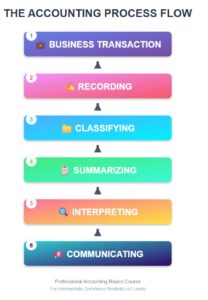
Accounting is often referred to as the “language of business.” It is a systematic process of recording, classifying, summarising, and interpreting financial transactions.
Simple Definition: Accounting is the art of recording financial transactions in books of account.
Technical Definition: Accounting is the process of identifying, measuring, recording, and communicating economic information to permit informed judgments and decisions by users of the information.
Why Do We Need Accounting?
Every business needs to track its financial activities. Here’s why accounting matters:
- Track Income and Expenses – Know where money comes from and where it goes
- Make Informed Decisions – Use financial data to plan for the future
- Legal Compliance – Meet government and tax requirements
- Measure Performance – Understand if the business is profitable
- Attract Investors – Show financial health to potential investors
Objectives of Accounting
Accounting serves several important purposes:
|
Objective |
Purpose |
|
Recording Transactions |
Keep systematic records of all business dealings |
|
Calculating Profit/Loss |
Determine whether the business is making money |
|
Financial Position |
Show what the business owns and owes |
|
Legal Compliance |
Maintain records as required by law |
|
Planning & Control |
Help management make better decisions |
|
Fraud Prevention |
Detect and prevent financial irregularities |
Who Uses Accounting Information?
Different people need accounting information for different reasons:
Internal Users
- Owners – To know profitability and growth
- Management – To make business decisions
- Employees – To understand job security and benefits
External Users
- Investors – To decide whether to invest money
- Creditors – To assess creditworthiness
- Government – For taxation and regulation
- Banks – To evaluate loan applications
- Customers – To check business stability
- Researchers – For academic and market studies
Types of Accounting
Accounting can be divided into different branches:
- Financial Accounting
- Records daily business transactions
- Prepares financial statements
- Focuses on historical data
- Mandatory for all businesses
- Example: Recording sales, purchases, and expenses
- Cost Accounting
- Tracks production and operational costs
- Helps in cost control and reduction
- Used mainly by manufacturing firms
- Example: Calculating cost per unit of production
- Management Accounting
- Provides information to managers
- Helps in planning and decision-making
- Focuses on future predictions
- Not mandatory but highly useful
- Example: Budgeting and forecasting
Comparison Table
|
Feature |
Financial Accounting |
Cost Accounting |
Management Accounting |
|
Users |
External & Internal |
Internal |
Internal |
|
Time Focus |
Past |
Past & Present |
Future |
|
Legal Requirement |
Mandatory |
Optional |
Optional |
|
Reporting Period |
Annual/Quarterly |
As needed |
As needed |
|
Main Purpose |
Show financial position |
Control costs |
Aid decision-making |
Accounting as a Language of Business
Just as English or Hindi helps us communicate, accounting helps businesses communicate their financial story.
How it works:
- Words = Account names (Cash, Sales, Rent)
- Grammar = Accounting principles and rules
- Sentences = Journal entries
- Paragraphs = Financial statements
This universal language allows anyone worldwide to understand a business’s financial health.
Key Concepts in Accounting
- Recording Financial Transactions
- Every business activity involving money is recorded
- Recorded in the books of accounts
- Must be done systematically and chronologically
- Example: When you buy goods for ₹10,000, this transaction is recorded immediately
- Classifying Business Data
- Similar transactions are grouped together
- Done through ledger accounts
- Makes information easy to find and use
- Example: All sales are posted to the Sales Account
- Summarising Financial Information
- Data is condensed into meaningful reports
- Creates trial balance and financial statements
- Converts detailed records into useful summaries
- Example: Monthly sales of ₹5,00,000 shown as one figure
- Interpreting Financial Results
- Analysing what the numbers mean
- Understanding trends and patterns
- Comparing with past performance
- Example: Profit increased by 15% compared to last year
- Communicating Business Performance
- Sharing financial information with stakeholders
- Through annual reports and statements
- Must be clear, accurate, and timely
Example: Presenting profit/loss statement to owners
Key Points to Remember
✓ Accounting records all money-related business activities
✓ It helps in decision-making and legal compliance
✓ Both internal and external users need accounting information
✓ Three main types: Financial, Cost, and Management Accounting
✓ Accounting is the universal language of business
✓ The process involves: Recording → Classifying → Summarizing → Interpreting → Communicating
✓ Great career opportunities available for qualified professionals
Practice Questions
- Define accounting in your own words.
- List any five users of accounting information.
- Differentiate between financial accounting and management accounting.
- Why is accounting called the language of business?
- Name three professional accounting qualifications in India.