Accounting Principles and Concepts
Introduction
Accounting principles are the foundation of financial reporting. They provide standardised guidelines for recording and presenting financial information. These principles ensure consistency across all organisations. They help stakeholders make informed decisions.
Why are they important?
- Create uniformity in financial reporting
- Build trust among investors and creditors
- Enable comparison between different companies
- Maintain transparency in business operations
Generally Accepted Accounting Principles (GAAP)
GAAP is a comprehensive framework of accounting standards. Companies must follow these rules when preparing financial statements.
Key points about GAAP:
- Established by the Financial Accounting Standards Board (FASB) in the US
- International companies often use IFRS instead
- Ensures reliability and comparability of financial data
- Protects the interests of all stakeholders
Fundamental Accounting Concepts
- Business Entity Concept
Core Principle: The business is separate from its owner.
What this means:
- Business transactions must be kept separate from personal transactions
- The owner’s personal assets are not business assets
- Personal expenses cannot be treated as business expenses
Real-world example:
John invests $100,000 to start a restaurant.
- This is recorded as capital in business books
- It’s not shown as John’s personal asset
- If John takes $5,000 for personal use, it’s recorded as drawings
- It cannot be shown as a business expense
Common mistakes:
- Using business cash for personal shopping
- Mixing personal and business bank accounts
- Recording family expenses as business costs
- Going Concern Concept
Core Principle: The business will continue operating indefinitely.
What this means:
- Financial statements assume ongoing operations
- Assets are valued for continued use, not immediate sale
- Long-term planning is reflected in accounting
Impact on financial statements:
- Assets shown at cost, not liquidation value
- Depreciation spread over useful life
- Long-term liabilities are acceptable
Example:
- Machinery costs $50,000
- Useful life: 10 years
- Depreciated over 10 years, not valued at resale price
- Money Measurement Concept
Core Principle: Only monetary transactions are recorded.
What can be recorded:
- Cash purchases and sales
- Asset acquisitions
- Expense payments
- Revenue earned
What cannot be recorded:
- Employee skills and morale
- Customer loyalty
- Brand reputation
- Management quality
Real-world application:
A company has excellent staff and strong customer relationships.
- These are valuable assets
- But they cannot be measured in money
- Therefore, they don’t appear on the balance sheet
- Accounting Period Concept
Core Principle: Financial performance is measured over specific time periods.
Common accounting periods:
- Monthly (for internal reports)
- Quarterly (3 months)
- Annually (fiscal year)
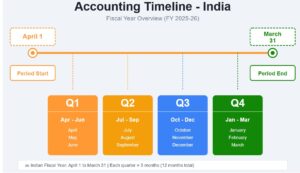
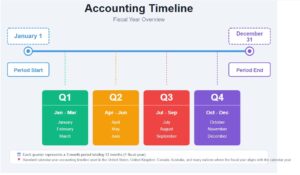
Accounting Timeline
Standard calendar year accounting timeline used in countries like the United States, the United Kingdom, Canada, Australia, and many other nations where the fiscal year aligns with the calendar year.
Why it matters:
- Enables regular performance evaluation
- Allows comparison across periods
- Helps in planning and budgeting
- Required for tax purposes
- Cost Concept
Core Principle: Assets are recorded at their original purchase price.
Key features:
- Also called the Historical Cost Concept
- Provides objectivity and verifiability
- Market value changes are ignored
- Easy to prove with original invoices
Example:
|
Year |
Event |
Book Value |
Market Value |
|
2020 |
Land purchased |
$200,000 |
$200,000 |
|
2023 |
No transaction |
$200,000 |
$280,000 |
|
2025 |
No transaction |
$200,000 |
$350,000 |
The land stays at $200,000 in books regardless of market value.
- Matching Concept
Core Principle: Match expenses with the revenues they generate.
How it works:
- Record expenses in the same period as related revenue
- Ensures accurate profit calculation
- Provides a true picture of performance
Real-world example:
A retailer sells goods in December 2024:
- Sale amount: $50,000
- Customer pays in January 2025
- Cost of goods: $30,000
Correct recording:
- Revenue: Recorded in December 2024
- Expense: Recorded in December 2024
- Both matched in the same period
Common scenarios:
|
Situation |
Revenue Recognition |
Expense Recognition |
|
Cash sale |
Immediately |
Immediately |
|
Credit sale |
At the sale date |
At the sale date |
|
Salaries |
When earned |
When incurred |
|
Advertising for future sales |
Future period |
Current period |
- Realization Concept
Core Principle: Recognise revenue when earned, not when cash is received.
Revenue is recognised when:
- Goods are delivered or services performed
- Amount is reasonably certain
- Collection is probable
Three scenarios:
Scenario 1: Cash Sale
- Goods delivered: March 1
- Cash received: March 1
- Revenue recorded: March 1
Scenario 2: Credit Sale
- Goods delivered: March 1
- Cash received: April 15
- Revenue recorded: March 1
Scenario 3: Advance Payment
- Cash received: March 1
- Goods delivered: April 15
- Revenue recorded: April 15
Common mistake: Recording revenue when an advance is received, not when goods are delivered.
- Dual Aspect Concept
Core Principle: Every transaction has two effects.
The Accounting Equation:
ASSETS = LIABILITIES + OWNER’S EQUITY
This equation must always balance.
Example: Purchase equipment for $10,000 cash
Before Transaction:
Assets = $50,000
Liabilities = $20,000
Equity = $30,000
Transaction Effect:
Equipment (Asset) +$10,000
Cash (Asset) -$10,000
After Transaction:
Assets = $50,000 (no change)
Liabilities = $20,000 (no change)
Equity = $30,000 (no change)
Another example: Borrow $20,000 from the bank
|
Account |
Type |
Effect |
Amount |
|
Cash |
Asset |
Increases |
+$20,000 |
|
Bank Loan |
Liability |
Increases |
+$20,000 |
Both sides of the equation increase equally.
How Principles Guide Daily Accounting
When recording any transaction, ask these questions:
Checklist for Recording Transactions:
- Business Entity: Does this belong to the business?
- Money Measurement: Can it be expressed in monetary terms?
- Accounting Period: Which period does it belong to?
- Cost Concept: What was the original cost?
- Matching: Does it relate to any revenue?
- Realisation: Has revenue actually been earned?
- Dual Aspect: What are the two effects of this transaction?
- Going Concern: Is this for ongoing operations?
Common Mistakes to Avoid
Business Entity Violations:
- Paying personal rent from a business account
- Using the company car for a family vacation
- Recording spouse’s salary when they don’t work
Matching Concept Errors:
- Recording December sales in January
- Expensing the entire insurance premium at once
- Not matching the cost of goods with sales
Realisation Concept Mistakes:
- Recording revenue when the order is received
- Recognising income from advance payments
- Booking sales before goods are shipped
Cost Concept Errors:
- Revaluing assets based on market prices
- Recording assets at estimated values
- Adjusting land value due to appreciation
Dual Aspect Failures:
- Recording only one side of the transaction
- Unbalanced journal entries
- Missing corresponding debit or credit
Impact on Financial Statements
Balance Sheet:
- Shows assets at historical cost
- Reflects business entity only
- Assumes going concern
- Must balance (dual aspect)
Income Statement:
- Covers a specific accounting period
- Matches revenues with expenses
- Recognises revenue when earned
- Shows only monetary items
Cash Flow Statement:
- Reports actual cash movements
- Organised by accounting period
- Separates business from personal flows
Summary Table: Principles at a Glance
|
Principle |
Key Point |
Example |
|
Business Entity |
Business ≠ Owner |
The owner’s car isn’t a company asset |
|
Going Concern |
Business continues |
Depreciate, don’t liquidate |
|
Money Measurement |
Only $ recorded |
Employee’s skill was not recorded |
|
Accounting Period |
Specific timeframes |
Annual/quarterly reports |
|
Cost |
Original price |
Land at purchase price |
|
Matching |
Expense with revenue |
Cost of goods sold |
|
Realization |
Earn, not receive |
Credit sale: record at delivery |
|
Dual Aspect |
Two effects always |
Buy asset: +asset, -cash |
Conclusion
These eight principles form the backbone of accounting. They work together to create reliable financial information. Master them early in your studies. They apply to every transaction you’ll ever record.
Key points to remember:
- Principles ensure consistency
- They protect stakeholder interests
- They make financial data comparable
- They’re based on logic, not arbitrary rules
Next steps:
- Practice identifying principles in real transactions
- Review financial statements with these concepts in mind
- Apply them in your accounting exercises
- Understand how violations affect financial reporting
These concepts will become second nature with practice. They’re essential for your accounting career.