The journey toward cracking competitive examinations is as much a test of time management as it is of knowledge and aptitude. In the crucible of preparation, where thousands of pages must be mastered and countless problems solved, time becomes the most precious commodity.
As the Bhagavad Gita wisely counsels, “योगः कर्मसु कौशलम्” (Yogah karmasu kaushalam) — Excellence in action lies in skilfulness, and nowhere is this more applicable than in managing one’s preparation time effectively.
Understanding the Time Paradox
Competitive exam aspirants often face a peculiar challenge: an overwhelming syllabus coupled with limited preparation time. The anxiety this creates can be paralyzing. However, ancient Indian wisdom offers profound insights.
Swami Vivekananda once said, “Take up one idea. Make that one idea your life; dream of it; think of it; live on that idea.” This principle of focused attention forms the bedrock of effective time management.
The key lies not in finding more time, but in using available time with greater wisdom and precision.
The Foundation: Planning with Purpose
Strategic Planning Framework:
- Macro Planning: Divide your preparation timeline into phases (Foundation, Advanced, Revision)
- Micro Planning: Break weekly goals into daily actionable tasks
- Flexibility Buffer: Reserve 15-20% of your schedule for unexpected situations
Chanakya, in his Arthashastra, emphasised, “Before you start some work, always ask yourself three questions: Why am I doing it? What the results might be? Will I be successful?” Apply this to your study plan. Every hour invested should serve a clear purpose toward your ultimate goal.
Time Allocation Strategy
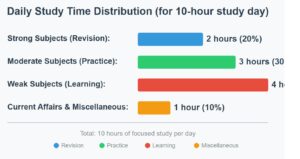
This distribution ensures you strengthen weaknesses while maintaining strengths, following the principle of balanced development.
The Four Pillars of Effective Time Management
- Prioritisation: The Eisenhower Matrix Approach
Categorise your tasks:
- Urgent & Important: Mock tests, revision before exams
- Important but Not Urgent: Conceptual learning, building fundamentals
- Urgent but Not Important: Responding to study group queries
- Neither Urgent nor Important: Excessive social media browsing
Focus 70% of your energy on the “Important but Not Urgent” quadrant — this is where real preparation happens.
- Deep Work Sessions
The Upanishads teach us about “Ekagrata” — one-pointedness of mind. Modern research validates this ancient wisdom through the concept of deep work. Structure your day around 90–120-minute focused study blocks:
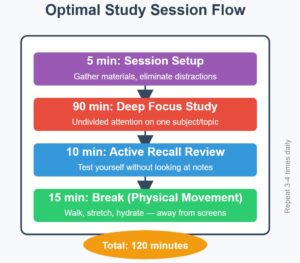
During these sessions, eliminate all distractions. As the Buddha taught, “The mind is everything. What you think, you become.” Your undivided attention during study time determines the quality of your preparation.
- The Power of Morning Hours
Ancient Indian tradition emphasises “Brahma Muhurta” — the pre-dawn hours between 4:30 AM and 6:00 AM, considered most conducive to learning. Modern science confirms that cognitive abilities peak in the morning hours. Dedicate these precious hours to:
- Complex problem-solving
- Learning new concepts
- Memorisation of difficult material
- Active Learning Techniques
Mere passive reading wastes time. Employ active recall and spaced repetition:
- After studying a topic, close your book and write what you remember
- Review material at increasing intervals (1 day, 3 days, 7 days, 21 days)
- Teach concepts to others or explain them aloud to yourself
Time Traps to Avoid
The Illusion of Productivity: Spending hours studying without retention is worse than not studying at all. Quality trumps quantity.
Perfectionism Paralysis: Adi Shankaracharya’s philosophy of “Sadhana” (practice) reminds us that consistent effort matters more than perfect execution. Done is better than perfect.
Social Media Quicksand: A “quick check” of social media rarely remains quick. Use apps that block distracting websites during study hours.
Recovery and Renewal
The Bhagavad Gita states, “योगस्थः कुरु कर्माणि” (Yogasthah kuru karmani) — Established in equanimity, perform your actions. This balance is crucial. Include in your schedule:
- 7-8 hours of sleep (non-negotiable)
- 30 minutes of physical exercise
- 15 minutes of meditation or breathing exercises
- One day per week for complete mental relaxation
These are not luxuries but necessities that enhance your cognitive performance and prevent burnout.
Conclusion
Time management for competitive exams is not about mechanical scheduling but about conscious, purposeful engagement with your preparation. As Rabindranath Tagore beautifully expressed, “You can’t cross the sea merely by standing and staring at the water.” Your dreams of success require systematic action, disciplined time utilisation, and unwavering focus.
Remember, every great achiever once stood where you stand today. The difference lies not in the time they had, but in how they used it. Begin today with clarity, proceed with consistency, and success will inevitably follow. “कर्मण्येवाधिकारस्ते मा फलेषु कदाचन“ — You have the right to perform your duty, but you are not entitled to the fruits of action. Focus on managing your time and effort; results will follow naturally.