Buy Paperback
Chanakya’s Justice: When a 2,300-Year-Old Text Speaks to Today’s Courts
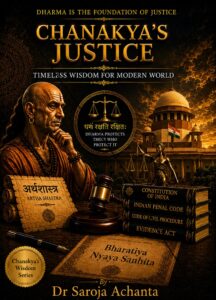
Ancient legal systems are often underestimated in the breadth and sophistication of their jurisprudential thought. Kautilya’s Arthashastra – composed in India around 300 BCE stands as a compelling corrective to that assumption. Dr Saroja Achanta’s newly published book, Chanakya’s Justice: Timeless Wisdom for Modern World, brings this remarkable treatise into systematic dialogue with twenty-first-century law, yielding insights of considerable scholarly and practical significance.
What Is the Arthashastra?
Written by Kautilya – also known as Chanakya or Vishnugupta the Arthashastra is a comprehensive treatise on law, statecraft, governance, and international relations. Lost for nearly a millennium, it was rediscovered in 1905 and has since been recognised as one of the most sophisticated legal texts the ancient world produced. It predates the Magna Carta by 1,500 years and was composed in the same era as Aristotle’s Politics.
What Does Chanakya’s Justice Cover?
Across seven richly researched chapters, the book maps Kautilyan doctrine against every major domain of modern law:
- Constitutional law and the rule of law – Kautilya’s concept of Rājadharma and its striking parallels with separation of powers
- Criminal justice – the Daṇḍa theory of proportionate punishment, two millennia before modern sentencing guidelines
- Contract and commercial law – Vyavahāra principles that anticipate consumer protection and trade regulation
- Administrative law – a forty-point embezzlement taxonomy that reads like an early blueprint for India’s anti-corruption legislation
- International law – the Rājamandala theory, diplomatic immunity, and laws of armed conflict that predate the Geneva Conventions
Why Does This Matter for Law Students and Practitioners?
India’s legal system today is built on a colonial framework that largely did not engage with its own jurisprudential heritage. Dr Achanta argues – with considerable force – that this represents a missed opportunity for enriching contemporary legal thought. The Arthashastra theorised:
- Judicial independence and court structure with remarkable precision
- Rights of the accused, including protections against self-incrimination
- Consumer safeguards against adulteration, price manipulation, and fraudulent trade practices
- Diplomatic immunity – codified centuries before the Vienna Convention on Diplomatic Relations, 1961
For competitive exam aspirants, the book is equally valuable. It contextualises UPSC and judicial services topics – constitutional law, IPC, BNS, administrative accountability – within a uniquely Indian intellectual tradition.
The Method: Rigorous, Honest, Comparative
Crucially, this is not a work of uncritical celebration. Dr Achanta examines the Arthashastra with a scholar’s discipline: acknowledging where Kautilya’s era produced unjust hierarchies of caste, gender, and punishment, while identifying the principles that have genuinely endured. Every Sanskrit verse appears in Devanāgarī with IAST transliteration and a fresh English translation, grounded in the three canonical editions: Shamasastry (1915), Kangle (1960–65), and Olivelle (2013).
“India’s legal heritage is not derivative of the modern West – it is independent, ancient, and in significant respects deserving of equal scholarly recognition.“ – Dr Saroja Achanta, Preface
Chanakya’s Justice is available now. ISBN 978-93-5916-471-7. It is essential reading for law students, legal practitioners, policy makers, and anyone who believes that the pursuit of justice is a craft enriched by the full depth of human experience – including, especially, our own.